Meet Dr. Mercedes DePaolo, DVM, DAVDC!

Have you ever bought your dog an elk antler or a hard marrow bone thinking it would help clean their teeth? According to board-certified veterinary dentist Dr. Mercedes DePaolo, those ultra-hard chews are actually one of the biggest culprits behind fractured teeth in pets.
For this edition of Paws and Pearly Whites, I spoke with Dr. DePaolo, founder of Utah Veterinary Dentistry. Originally trained in neuroscience before discovering her passion for veterinary oral surgery, she now works closely with veterinarians and pet families across Utah to treat everything from broken teeth and hidden foxtails to complex oral tumors and feline stomatitis.
In our conversation below, Dr. DePaolo shares her “fingernail rule” for safe chews, debunks common myths about canine tooth extractions, and explains why simply looking in your pet’s mouth once a week can make all the difference.
When did you first realize that you wanted to pursue veterinary medicine, and was there a defining moment that set you on that path?
I was a senior in college working on my thesis in neuroscience. My advisor noticed how attached I was to the rats we were using in our experiments and suggested that veterinary medicine might be a good career path for someone who loves science and animals. It had never occurred to me prior to that!
What was the pivotal moment during your veterinary education or early practice that made you choose to dedicate your career specifically to dentistry and oral surgery?
I went into vet school thinking that dentistry was a waste of time and that I wanted nothing to do with it. However, I did really enjoy surgery. In order to fill an elective requirement, I took a dentistry course which included cadaver practice. I realized how surgical dentistry was and decided to take the dentistry and oral surgery rotation during my fourth year. Once I experienced the instant gratification of eliminating oral pain in pets, I was hooked! I also loved the variety of the procedures that Veterinary Dentists perform: jaw fracture repair, root canals, extractions, oncologic surgeries, etc.
What is the most rewarding part of running Utah Veterinary Dentistry?
I have been very fortunate to have had the opportunity to develop close relationships with the referring veterinary community in Utah. Although I have always been available via text or phone to my referring veterinarians, being able to actually interact with them in person on a semi-regular basis has been wonderful.
What is the weirdest, funniest, or most unexpected thing you’ve ever found wedged between a pet’s teeth or stuck to the roof of their mouth?
Unfortunately, it’s not unexpected, but I have found so many foxtails! I also find them lodged in the tonsillar fossae routinely, so I always make sure to check the tonsils thoroughly at every anesthetized exam

Many pet parents purchase natural elk or deer antlers and hard marrow bones thinking they are healthy, natural options. What is your clinical stance on these dense chew item?
I joke that these items keep me in business because I have to treat so many pets whose teeth fractured while chewing them. Joking aside, I strongly recommend against giving these to pets. My rule of thumb is that if it cannot be indented with a fingernail, it is hard enough to fracture a tooth. This includes nylon bones and bully sticks. Although these objects may help keep teeth cleaner by mechanically removing plaque and calculus, it doesn’t do any good to keep a tooth clean and then have a catastrophic fracture.
What is the biggest myth about pet dental care you find yourself constantly debunking?
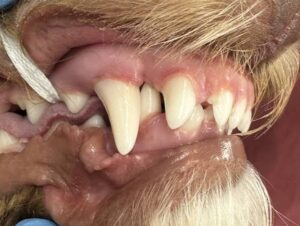
I do not like the fearmongering associated with extracting mandibular canines. So many pet owners come to me having been told that extracting the mandibular canine tooth will severely weaken the mandible. While it is true that the root of the canine teeth take up a large portion of the mandible, the alveolus (tooth socket) will fill in with bone within months in a dog with a healthy jaw. Of course, there are exceptions to this, but owners of a young German Shepherd should never be told that extracting the mandibular canine is going to predispose their dog to future jaw fracture.
For an owner whose dog or cat runs away the second they see a toothbrush, what are realistic, low-stress ways to protect their teeth without turning it into a daily wrestling match?
First, I would work on reversing the negative association with the toothbrush so that the pet doesn’t run away when they see it. For a month (or more), start by bringing the toothbrush out and giving them a treat without going anywhere near the mouth. Eventually, they can work up to brushing their teeth, but I see so many pet owners rushing the process. I know they have the best intentions, but I would rather see progress than perfection!
In terms of supplements, water additives, and chews, I am not a huge believer in these. They may help incrementally, but they will never help as much as brushing, and I find pet owners spending huge amounts of money on them and/or overfeeding their pets with dental treats. The one type of product I am interested in is hyaluronic acid, which I have anecdotally seen help immensely with oral inflammation.
Veterinary dentistry is advancing rapidly. Looking at modern technology and surgical techniques, what innovation or shift in the field are you most excited about right now?
I am anxiously awaiting new products in the pipeline for treating feline chronic gingivostomatitis (FCGS). There are multiple researchers trying to understand what causes this horrible condition, and it seems like we are getting closer every day. At the same time, treatments such as stem cells, antivirals, and hyaluronic acid are being tested as an adjunct to full mouth extractions. At this time, there is no rigorous published evidence supporting the newer antivirals, and the long-term safety of these medications is still unknown, so I am hoping those studies will be undertaken soon. There is published evidence for mesenchymal stem cells and hyaluronic acid, and a commercially available stem cell product will hopefully be available in the future.
If you could share just one piece of advice with every dog and cat parent about protecting their pet’s oral health and comfort, what would it be?
Even if you cannot brush your dog or cat’s teeth, please look in their mouth once a week if you can. This will enable you to notice if there are any new fractures, growths, or other issues, which are much easier to treat the sooner we find them!
