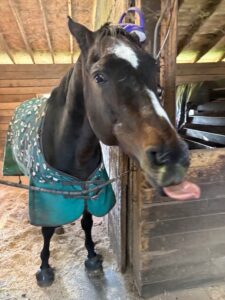
The horse’s mouth is a dynamic structure essential for eating, carrying a bridle, and establishing soft rein contact. While a horse may be showing signs of discomfort or pain due to their teeth prior to losing weight, adult horses will typically display behavioral issues while being ridden.
How Horse Teeth Work
Adult horses possess anywhere from 36 to 44 permanent (hypsodont) teeth. Hypsodont teeth are defined by having a high crown that is stored below the gum line and continually erupts into the mouth.
The eruption process occurs in small increments of approximately two to three millimeters per year. In addition to the slow eruption of new teeth, the grinding action of consuming forage constantly wears away these teeth at the same rate.
Due to the fact that the upper portion of the horse’s jaw is larger than its lower jaw, the cheek teeth naturally experience uneven wear.
Sharp Enamel Points
The most common dental issue in horses is sharp pointed enamel edges. Sharp pointed enamel edges occur on the outside edges of the upper cheek teeth (premolars and molars) and inside edges of the lower cheek teeth.
These sharp pointed edges bite into the horse’s cheeks and tongue, creating ulcers.
In addition, a noseband or a bit can also cause the soft tissue to be pressed against these sharp edges, creating discomfort for the horse and is the reason many horses react with resistance to contact.
Hooks, Ramps, and Wave Mouth
Overgrowth occurs when the upper and lower teeth don’t meet properly. Hooks generally grow as an overgrowth on either the first upper cheek tooth or the last lower molar. Ramps are very tall overgrowth on the front lower cheek teeth.
Wave mouth and step mouth occur when there is an uneven rate of wear on some teeth, so they are worn down more quickly than other teeth, resulting in an uneven grinding surface. Both wave mouth and step mouth will restrict jaw movement and result in pain while eating.
Wolf Teeth and Retained Caps
Wolf teeth are small, relatively shallow-rooted teeth located in front of the first upper cheek tooth. Many veterinarians recommend removal of wolf teeth prior to a horse’s formal start as an equine athlete, as they often hinder the horse’s ability to accept a bit.
Horses lose their deciduous (baby) teeth when between two and five years of age. Occasionally the cheek tooth cap fails to exfoliate (fall off), which may cause discomfort, bumps along the jaw area, and/or poor intake until it is professionally removed.
Diastemata and Gum Disease
Diastemata occur when there is an abnormally large gap (space) between adjacent teeth. Feed will pack into diastemata and begin to rot, thereby creating a potential for periodontal disease.
Of all the painful dental afflictions that horses suffer from, this is arguably one of the most painful. Older horses have a greater propensity for developing diastema and associated problems.
Fractures, Root Infections, and EOTRH
Cheek teeth can break due to injury or infection that has penetrated through the tooth. When an upper cheek tooth is affected by an infected root, it can infect the sinuses, which will result in a foul smelling nasal discharge. A lower root that becomes infected typically results in a hard mass that forms on the jaw.
Older horses have a dental issue known as EOTRH (Equine Odontoclastic Tooth Resorption and Hypercementosis), which affects their incisors and canines, resulting in swelling of the gum area and the eventual loss of the tooth.
Signs of Dental Problems
Look for signs such as quidding (dropping food while trying to eat), eating slowly, losing weight, having long fibers in manure, having bad breath, and having your horse toss its head.
At the ride, look for the same signs along with behaviors such as fighting the bridle, leaning into one side of the bridle, or refusing to turn when asked.
Prevention and Treatment
Most horses will require a yearly (or biannual) dental check-up; many younger horses and older horses will likely require regular dental examinations at an increased frequency.
The veterinarian performing the examination will use sedation, a full-mouth speculum, and a high-intensity light source to allow for an inspection of all teeth.
Once the inspection is complete, floating (the process of carefully grinding off sharp edges and excess growths on the teeth) is used to restore balance to the way that the upper and lower jaws meet when eating.
In severe instances of malocclusion or infection within the jaw, X-ray imaging, extraction of affected teeth, or antibiotic therapy may be required as treatment options.
Conclusion
Many of these riding issues have their roots in a problem area in the horse’s mouth. While we often think a horse is being stubborn or “attitude-y” when it begins to toss its head or fight the bit, I believe this is many times just because the horse is uncomfortable.
By having your veterinarian regularly check your equine for any potential dental problems, by treating them as soon as you find out there is an issue, and by feeding them as much quality forage as possible, you will have helped to keep your equine comfortable. These practices will also aid in helping your equine maintain a healthy weight, remain happy, and therefore be willing to work under the bridle.
- AAEP – Recognizing Dental Problems:
[https://aaep.org/resource/learn-to-recognize-your-horses-dental-problems/](https://aaep.org/resource/learn-to-recognize-your-horses-dental-problems/)
- Patterson Vet – AAEP Dental Care Guidelines Summary:
[https://blog.pattersonvet.com/aaep-equine-dental-care-guidelines](https://blog.pattersonvet.com/aaep-equine-dental-care-guidelines)
- Merck Veterinary Manual – Dental Disorders of Horses:
[https://www.merckvetmanual.com/horse-owners/digestive-disorders-of-horses/dental-disorders-of-horses](https://www.merckvetmanual.com/horse-owners/digestive-disorders-of-horses/dental-disorders-of-horses)
- University of Florida IFAS Extension – Equine Dental Care:
[https://ask.ifas.ufl.edu/publication/VM273](https://ask.ifas.ufl.edu/publication/VM273)
- UConn Extension – Basic Equine Dental Care:
[https://extension.uconn.edu/publication/equine-dental/](https://extension.uconn.edu/publication/equine-dental/)
