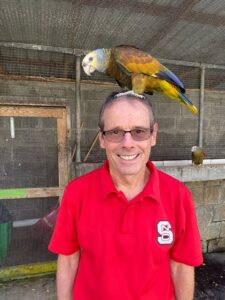
Meet Dr. Gregory A. Lewbart, MS, VMD, DACZM
Most people think of veterinary dentistry as cleaning a dog’s teeth or checking a cat’s gums—but what happens when your patient is a pufferfish with overgrown teeth, a box turtle with an elongated beak, or a 15-year-old pet tarantula?
For this edition of Paws and Pearly Whites, I had the honor of interviewing Dr. Gregory A. Lewbart, Professor of Aquatic, Wildlife, and Zoological Medicine at North Carolina State University’s College of Veterinary Medicine. A board-certified specialist in zoological medicine (DACZM), Dr. Lewbart has spent decades treating and studying an extraordinary range of creatures—from local North Carolina fish and amphibians to marine iguanas and seabirds in the Galápagos Islands.
In our conversation below, Dr. Lewbart shares how volunteering at a vet clinic at age 14 launched his career, why natural diets are the secret to healthy teeth and beaks in exotic pets, and what wildlife conservation teaches us about protecting species great and small.

When did you first realize you wanted to pursue veterinary medicine—and what drew you
specifically to exotic, aquatic, and wildlife species rather than traditional cats and dogs?
When I was about 12 years old our cat was hit by a car and survived, with a veterinarian’s
help. I was always fascinated with all kinds of animals and started volunteering for a
veterinarian named Dr. Bookman when I was 14. When I was 16, I started working for him
and did so all through high school. It was primarily a dog and cat practice. It wasn’t until I
got to graduate school in Boston when my interest truly shifted to aquatic animal and
herptile medicine.
You have treated everything from sea turtles and sharks to spiders, koi, and Galapagos
tortoises. What is the single most surprising or memorable dental, beak, or oral procedure
you’ve ever been involved in?
Great question! You are well informed. A 15-year-old pet tarantula named Frida presented
with a fang she was unable to extend. This caused her problems eating. We performed an
MRI to help with the diagnosis. In the end, we couldn’t save her, but we learned a lot and the
case was published in a scientific journal. I also had to trip an overgrown beak on an eastern
box turtle named Michael Jordan (the owner was a UNC fan).
As a professor at NC State, research is a huge part of your work alongside clinical care and
teaching. What research projects or studies are you and your team actively working on right
now?
Oh boy, lots of ongoing projects. These include health assessments of various wild North
Carolina fish species including dolphinfish, wahoo, yellowfin tuna, bluefish, and blacktip
sharks. I also have students working on health aspects of the native and endangered gopher
frog. In the Galapagos islands I have ongoing collaborative efforts with marine iguana health,
parasites of reptiles, seabird health, and the effects of El Niño events on wildlife. Last year I
brought veterinary students to Madagascar, and we have a paper coming out any day on
blood values and other biomarkers in wild panther chameleons. Next May we are hoping to
travel to Bermuda to research the health of native diamondback terrapins.
Working extensively with aquatic medicine and marine animals, how do dental issues present in
fish, sharks, or marine mammals—and how do you examine or treat a mouth in an aquatic
environment? I don’t do a lot of clinical work with marine mammals. In fact, there are no captive (under human care) marine mammals in the state of North Carolina. No dolphins, whales, seals, sea lions, or manatees. Sharks regrown their teeth and the most common problem we see with sharks, rays, and bony fishes are jaw/mouth related injuries, usually from inter or
intraspecific aggression. Next would probably be overgrown teeth of pufferfish that aren’t
receiving a diet that helps keep the teeth at the proper length. In these cases, we trim the
teeth with a Dremel and make dietary recommendations for the owner. Many wild turtles
present with jaw (mandible and maxilla) fractures secondary to vehicular trauma.
People often assume wild animals have naturally healthy teeth. From your conservation and
wildlife fieldwork—including projects in the Galápagos—what does oral disease actually look
like in wild populations compared to animals in human care?
I have looked into the mouths of hundreds of Galapagos animals and aside from an
occasional missing or broken tooth, I don’t recall observing much dental disease.
If you could share just one piece of advice with every owner of an exotic pet—whether a rabbit,
bearded dragon, parrot, or koi—about protecting their oral and overall health, what would it
be?
Make sure you are providing them with the highest quality and most natural diet possible.
Some animals, like rabbits, rodents, and some fish species continually grow their teeth. A
normal diet helps keep dental size and shape in check.
Many vet students and technicians dream of working with zoo, wildlife, or aquatic animals.
What advice do you give students who want to carve out a career in this specialized field?
Work hard, show up, and stick with your goals and dreams. Don’t listen (at least don’t
believe) people who tell you it’s too hard or too competitive.
Looking ahead at zoological and exotic medicine, what emerging research, technology, or
conservation breakthrough excites you the most right now?
I don’t like to lose. In 1987 my Mom sold all of my 1960’s and 1970’s baseball cards (a few
shoeboxes) at a garage sale for $10 (someone came early looking for cards). It wasn’t her
fault. Had I really wanted them I would have brought them to college, then graduate school,
then veterinary school with me. So I started a whole new collection of cards and other
memorabilia in the late 1980’s and early 1990’s. My collection is much, much better than it
ever was and I have over 700 autographed cards including many from hall of fame players. I
obtained nearly all of these by mailing cards to retired players. What does this have to do
with your question? I hate extinction of animals caused by humans. Especially the European
colonial powers that have wiped out dozens of species in the last 500 years (e.g. Steller’s sea
cow, great auk, passenger pigeon, Carolina parakeet, ivory-billed woodpecker, dodo bird,
thylacine, and many others). Recent advances in genomics are making it possible, or will
make it possible, to restore some of these species and introduce them to appropriate native habitats. I realize this process is not without controversy, but I firmly believe there can be
benefits.
Greg Lewbart | College of Veterinary Medicine
Gregory Lewbart, MS, VMD, DACZM, DECZM (ZHM) – Center for Galapagos Studies
